
Treasury Secretary Scott Bessent said Iran will have “no oil on the water” and “no revenues” this week—claims he made on The Axios Show—while senior Iranian officials publicly warned about mounting economic strain.
Bessent’s claim: zero oil at sea, zero revenue
“For the first time in history, since they started pumping oil, they will have no oil on the water this week,” Bessent said Saturday, adding, “They will have no revenues.” He attributed the situation to a three-stage U.S. strategy: an earlier “kinetic” military campaign, a naval “Iron Wall” blockade on Iranian oil shipments, and an ongoing push dubbed “Operation Economic Outcast” to isolate Tehran economically.
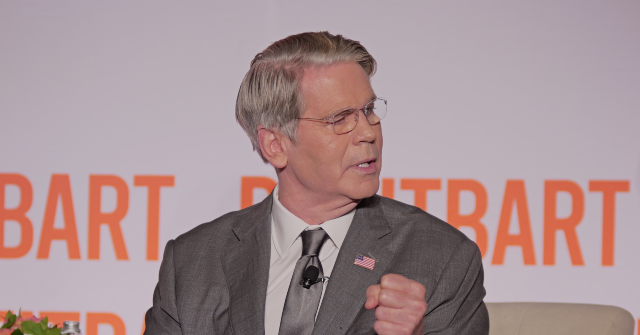
Bessent said the roughly six-week military operation that began in late February “destroyed their navy, their air force, substantially depleted their drone and missile capability, [and] destroyed their chances of rebuilding that.” He also asserted that U.S.-protected international commerce continues through the Strait of Hormuz while Iranian crude is blocked: “Right now, the score, in terms of barrels out of the strait: U.S. about 1.1 billion, Iran zero.”
The Treasury Department expanded sanctions Thursday to target Iran’s automotive and rail sectors and foreign suppliers, aiming to restrict resources available to the military, missile and drone programs, cyber operations, and the Islamic Revolutionary Guard Corps, according to Bessent.
Tehran signals economic stress
Inside Iran, Mohsen Rezaei, identified as the country’s top national security official, described the moment as among the most difficult periods Iran has faced during a high-level meeting with President Masoud Pezeshkian and senior ministers, according to state-run IRNA. Iranian state media did not publish Rezaei’s remarks verbatim. At the same meeting, Pezeshkian said conditions had worsened and that his government had adopted a “new posture” to manage “special conditions,” per the source text.
The rial traded around 2.69 million to the U.S. dollar Saturday after losing more than half its value over the past year, and inflation was described as above 70 percent in the source article. Iran’s central bank was said to be offering up to $2 billion in U.S. currency via state banks to support the rial.
The source article also cited Reuters in reporting that many Iranians are depleting savings, losing jobs, moving to cheaper areas, and cutting basic spending as prices surge and oil income declines.
Flows through Hormuz and the wider Gulf
Energy Secretary Chris Wright said Sunday that overall oil supplies moving through Hormuz have risen in recent weeks. Goldman Sachs analysts were cited estimating Persian Gulf exports at roughly 23.3 million barrels per day over the past week, returning to prewar levels, even as Iranian loadings collapsed.
War Secretary Pete Hegseth asserted that Iran does not control the strategic waterway. “They don’t control it. We do,” he said, adding that the U.S. blockade has been “ironclad.”
Talks, conditions, and threats
Iranian officials said Sunday that Washington had responded through intermediaries to Tehran’s latest proposal—previously rejected by President Donald Trump as insufficient—and that Tehran was reviewing the U.S. response, according to the source text.
Parliament Speaker Mohammad Bagher Ghalibaf said, “The Strait of Hormuz will not open until our seven conditions based on the Islamabad Memorandum are met.” Foreign Minister Abbas Araghchi argued that “there is no military solution, nor any solution based on new sanctions,” while warning that any renewed military confrontation would draw a “stronger” response from Iran.
U.S. deliberations and Iran’s military posture
Senior administration officials met at Camp David on Friday to discuss Iran, with Vice President JD Vance chairing and Secretary of State Marco Rubio, Hegseth, Bessent, CIA Director John Ratcliffe, White House envoy Steve Witkoff, and Joint Chiefs Chairman Gen. Dan Caine in attendance, according to the source article’s account of conversations with Axios. “Things were decided or at least deeply discussed,” one U.S. official was quoted as telling Axios.
Trump told reporters Friday, “If I told you, you would have a major story,” and on Saturday said he was approaching a decision: “Iran has been decimated. So the only question is it’ll either be the easy way or the hard way.”
Separately, Iran’s army announced Sunday it is increasing missile range and speed to reach adversaries up to 1,000 kilometers away, Brig. Gen. Mohammad Akraminia said, per the source text.
What’s next
Bessent maintains the U.S. can sustain its campaign and that Iran is days from having no oil at sea and no related revenue. Hegseth said the blockade can continue “as long as we need to,” urging Tehran to “make the right choice.” Iranian officials, meanwhile, insist negotiations must be based on their conditions and warn against further sanctions or military action.